Friday, 12 October 2012

Men's Clothing in INDIA . . .


Traditional Clothing


Dhoti


A dhoti is a six feet long white strip of cotton. This traditional attire is mainly worn by men in villages. It is held in place with the help of a belt, ornamental and embroidered or a flat and simple one, around the waist.
In south India men wear long, white sarong like sheets of cloth known as Mundu. In north and central Indian languages like Hindi, Marathi and Oriya, these are called dhothi, while in Telgu they are called Pancha ,in Tamil they are called veshti and in Kannada it is called Panche/Lungi. Over the dhoti, men wear shirts.

Women's Clothing in U.K.


Gown

In women's fashion, gown was used in English for any one-piece garment, but more often through the 18th century for an overgarment worn with a petticoat – called in French a robe. Compare this to the short gowns or bedgowns of the later 18th century.
Before the Victorian period, the word "dress" usually referred to a general overall mode of attire for either men or women, such as in the phrases "Evening Dress", "Morning Dress", "Travelling Dress", "Full Dress" and so on, rather than to any specific garment, and the most often English word for a woman's skirted garment was "gown". By the early 20th century, both "gown" and "frock" were essentially synonymous with "dress", although gown was more often used for a formal, heavy or full-length garment and frock or dress for a light-weight, shorter or informal one. Only in the last few decades has "gown" lost its general meaning of a woman's garment in the United States in favor of "dress". Today the usage is chiefly British except in historical senses or in formal cases such as evening gown and wedding gown. Formal gowns generally have a fitted bodice and a full-length full skirt.

Dress

dress is a garment consisting of a skirt with an attached bodice (or a matching bodice giving the effect of a one-piece garment). In Western culture, dresses are usually considered to be items of women's and girls' apparel.
The hemline of dresses can be as high as the upper thigh or as low as the ground, depending on the whims of fashion and the modesty or personal taste of the wearer.

Skirt

skirt is a tube- or cone-shaped garment that hangs from the waist and covers all or part of the legs
At its simplest, a skirt can be a draped garment made out of a single piece of material (such as pareos), but most skirts are fitted to the body at the waist and fuller below, with the fullness introduced by means of dart, gores, pleats, or panels. Modern skirts are usually made of light to mid-weight fabrics, such as denim, jersey, worsted, or poplin. Skirts of thin or clingy fabrics are often worn with slips to make the material of the skirt drape better and for modesty.
The hemline of skirts varies according to the personal taste of the wearer which can be influenced by such factors as social context, fashion , and cultural conceptions of modesty.

Womens Clothing In INDIA .....


Traditional Clothing

Sari:


A saree or sar is a female garment in the Indian subcontinent. A sari is a strip of unstitched cloth, ranging from four to nine metres in length, that is draped over the body in various styles. There are various traditional styles of saree: Sambalpuri Saree from East, Kanchipuram from South, Paithani from West and Banarasi from North among others. The most common style is for the sari to be wrapped around the waist, with one end then draped over the shoulder baring the midriff. The sari is usually worn over a petticoat. Blouse may be "backless" or of a halter neck style. These are usually more dressy with a lot of embellishments such as mirrors or embroidery and may be worn on special occasions. Women in the armed forces, when wearing a sari uniform, don a half-sleeve shirt tucked in at the waist. Teenage girls wear half-sarees, a three piece set consisting of a langa, a choli and a stole wrapped over it like a saree. Women usually wear full sarees.
Saris are known with different names in different places. In Kerala, white saris with golden border, are known askavanis and are worn on special occasions. A simple white sari, worn as a daily wear, is called a mundu. Saris are called pudavai in Tamil Nadu. In Karnataka, saris are called kupsas.

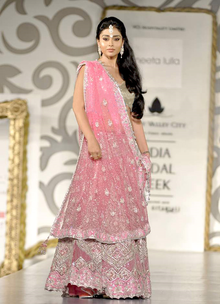
Ghagra Choli (lehenga choli)


A Ghagra Choli or a Lehenga Choli is the traditional clothing of women in Rajasthan and Gujarat. Punjabis also wear them and they are used in some of their folk dances. It is a combination of lehenga, a tight choliand a odhani. A lehenga is a form of long skirt which is pleated. It is usually embroidered or has a thick border at the bottom. A choli is a blouse shell garment, which is cut to fit to the body and has short sleeves and a low neck.
Different styles of ghagra cholis are worn by the women, ranging from a simple cotton lehenga choli as a daily wear, a traditional ghagra with mirrors embellished usually worn during navratri for the garba dance or a fully embroidered lehenga worn during marriage ceremonies by the bride.
Popular among unmarried women other than shalwar kameez are Gagra choli and Langa odhani.


Salwar Kameez


The salwar kameez is the traditional wear of women in PunjabHaryanaHimachal Pradesh and Kashmir and has become the most popular dress for females. It consists of loose trousers (the salwar) narrow at the ankles, topped by a tunic top (the kameez).It is often misnamed as "Punjabi suit" or simply "shalwar" in the north and "churidaar" in Southern India. Women generally wear adupatta or odani (Veil) with salwar kameez to cover their head and shoulders. It was introduced by the Muslims and originates from the Islamic era or old Iranian culture. It is very common in Pakistan and Afghanistan. It is always worn with a scarf called adupatta, which is used to cover the head and drawn over the bosom. The material for the dupatta usually depends upon that of the suit, and is generally of cottongeorgettesilkchiffon among others. This dress is worn by almost every teenage girl in lieu of western clothes. The salwar kameez is most common in the northwestern part of India. Many actresses wear the salwar kameez in Bollywood movies.


Churidaar Kurta

Churidaar is a version of salwar, which is loose up to knees and then fits the calf below. A salwar is a baggy pyjama with pleats which gets narrow at the ankles whereas churidaar fits below the knees with horizontal gathers near the ankles.Usually a long kurta, which goes below the knees, is worn with the churidaar.

Girl in plain churidaar kurta

[edit]

Fashion of UK . ..

As the UK is very much a western society - we wear very much the same as any other modern western society - ranging from Jeans and Tee shirts (whether with designer labels or not) to full business suits for office work (if required). Special clothers for the climate include heavy overcoats or anoraks for cold wintry weather to raincoats and umbrellas, for weather rain. Materials used cover every type and colour of fabric available, especially consider that Britain is a multi cultural society and in certain cities (Bradford for an example) you will find many stores with very colourful silk available for making in Sari's and other ethnic clothes.

Clothing In INDIA . . .

Clothing in India varies from region to region depending on the ethnicity, geography, climate and cultural traditions of the people of that region. Historically, men and women's clothing has evolved from simple Langotas and loincloths to cover the body to elaborate costumes not only used in daily wear but also on festive occasions as well as rituals and dance performances. In urban areas, western clothing is common and uniformly worn by people of all strata. India also has a great diversity in terms of weaves, fibers, colors and material of clothing. Color codes are followed in clothing based on the religion and ritual concerned. For instance, Hindus wear white clothes to indicate mourning while Parsisand Christians wear white to weddings.